Politics & Government
Home From War With TBI, Vet Battles DUI Rap in Peekskill
In a court case with potentially broader implications, an ex-marine maintains a traumatic brain injury, the scourge of today's battlefields, left him unjustly accused of being unfit to drive
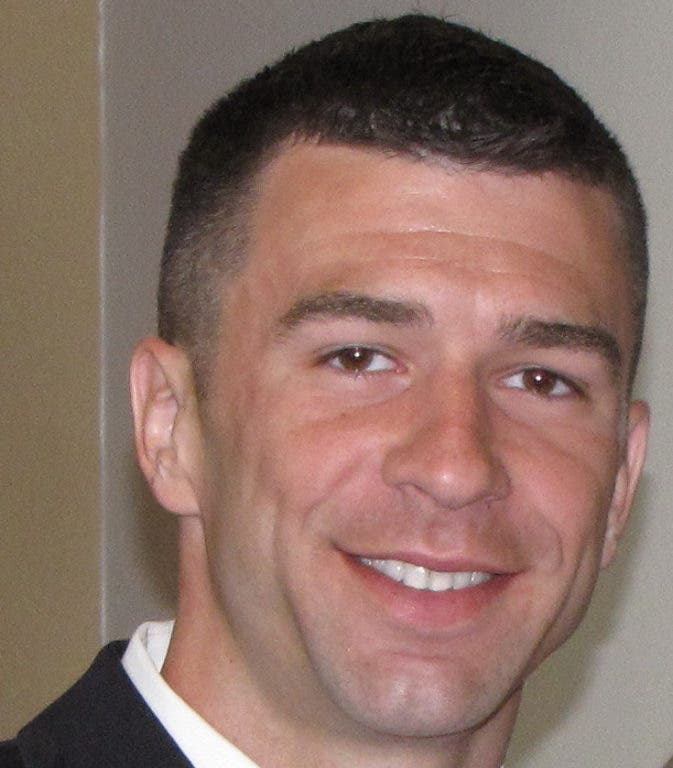
An Iraq combat veteran returns to today facing a tough choice: plead guilty to driving under the influence of drugs, ending a protracted, costly round of appearances, or demand a trial, which could leave him in legal limbo for another year or more. What separates Alexander A. Lazos from other DUI defendants, at least for now, is his likely defense.
After he brushed another car at a Peekskill gas station last July, police say, Lazos failed to walk a straight line and tested positive for drugs, leading to a charge of driving under their influence. The former marine, however, contends that a 2003 battlefield brain injury caused him to flunk the field sobriety test. The “drugs,” moreover, were doctor-prescribed for his injury and permitted even when driving, Lazos says.
With an estimated 20 percent of today’s combat veterans coming home with a traumatic brain injury—what medical professionals call the “signature wound” of Iraq and Afghanistan—chances are good that a now-exceptional defense could become more commonplace in courts nationwide. If so, police and prosecutors would increasingly be asked to recognize those combat scars and to separate the medically challenged from those who are, in fact, criminally intoxicated.
Find out what's happening in Peekskill-Cortlandtwith free, real-time updates from Patch.
Lazos' case has attracted the interest of Hudson Valley veterans. A clutch of former servicemen, rallied by veterans advocate William Nazario of Cortlandt Manor, stood shoulder to shoulder with Lazos outside court after his latest appearance, April 2. Nazario also spurred legislative action. In Albany, a bill proposes issuing identification cards that would allow all who have sustained a TBI to have documented proof of their condition.
Lazos, a 1999 graduate of Harriman’s Monroe-Woodbury High School, has moved to North Carolina since his arrest last July. He estimates that flying back for court appearances has already cost him about $8,000. Still, after his April 2 appearance in Peekskill court, Lazos rejected any talk of a plea deal. “How can I plead guilty when I didn’t do what they say?” he asks.
Find out what's happening in Peekskill-Cortlandtwith free, real-time updates from Patch.
Lazos, now 30, says he had just completed an appointment at Montrose last July 5 when he pulled into the Mobil station on Welcher Avenue, looking to buy a cold soft drink. The police later quoted another motorist as complaining that Lazos’ car had brushed his, causing minor bumper damage. Unaware he had clipped the other car, Lazos says, he was sitting on a curb, having his drink, when the police arrived.
Peekskill Police Officer Chatoyer Woodland inspected the Subaru that Lazos had been driving, found “minor damage” to the bumper, then talked with the operator. “Mr. Lazos . . . was swaying and could not keep his balance. While interviewing Mr. Lazos, he used his vehicle to keep his balance,” Woodland noted in his arrest report. “Mr. Lazos appeared to be under the influence of a prescription drug.”
The ID card legislation, introduced in Albany by state Sen. Greg Ball of Patterson, would allow anyone with a traumatic brain injury to document an alternative explanation for seeming intoxication. The bill, S6089, has been referred to the Senate Transportation Committee, where action is expected shortly, said Ball’s director of legislative affairs Krista Gobins. It has already won unanimous approval in the Committee on Veterans, Homeland Security and Military Affairs, which Ball chairs. A similar measure in the Assembly, A9473, is now before that chamber’s transportation panel.
Both bills note the ease with which TBI can mimic intoxication. “Common symptoms of TBI, even in mild cases, are dilation of one or both pupils of the eyes, slurred speech, weakness or numbness in the extremities, loss of coordination, and/or increased confusion, restlessness, or agitation,” the Ball legislation points out. “Due to these symptoms, a person diagnosed with TBI, even a mild case, can appear to be intoxicated, or under the influence of a controlled substance.”
Lazos failed the field sobriety test. Indeed, Woodland had to halt the trademark heel-to-toe walk because “Mr. Lazos almost fell and could not keep his balance.” Later, at the station, he came up positive for drugs. As a driver who can neither walk a straight line nor pass a drug test, Lazos looked like someone who had violated the law. But Lazos and his lawyer, David M. Hoovler of Chester, blame the veteran’s war wound on both counts. Since sustaining his TBI, Lazos insists, it’s impossible to meet the demands of the walk-and-turn sobriety test. “I don’t have that kind of coordination,” he says. “I can drive a car, but I’m sitting down to do that.”
Similarly, when Lazos tested positive for drugs, it was prescription medicine, not street narcotics, Hoovler said. Lazos identifies the substance only as antidepressants and says he showed the police his physician’s statement, Department of Motor Vehicles form MV-80, which cleared him to drive even while taking the medication.
Despite that, he was arrested. At the Peekskill police station, Lazos once again found himself within institution walls, a familiar venue for the better part of his adult life. Besides a five-year hitch with the Marines straight out of high school, he’s been to the VA’s Montrose facilities—mainly as an outpatient but including almost a year’s stay in the psychiatric unit—since returning from Iraq, where he suffered the TBI and acquired a post-traumatic stress disorder (PTSD).
In March 2003, in the early shock-and-awe days of the Iraq invasion, Sgt. Alexander Attila Lazos commanded a vehicle in the Marine Corps’ 2nd Light Armored Reconnaissance Battalion, part of the initial U.S. thrust. Less than a week after his fast-moving outfit rolled into the Iraq desert, Lazos found himself in the chaos of a nighttime firefight. Out of the blackness, with devastating suddenness and deafening impact, a blast knocked him senseless, hurling him from vehicle to ground.
Ears ringing but limbs intact, Lazos brushed off his close call, jumped back into the fight and went on to serve out his full tour. Throughout it, however—stricken with bouts of dizziness, nausea and bleeding from his ears—he found it increasingly harder simply to brush off the blast’s devastating effects.
When he returned to stateside duty, however, things did not improve. In 2004, growing mental and emotional disturbances finally forced Lazos to give up on a Marine Corps career and he was honorably discharged in August after five years in uniform. But back home in Harriman, his symptoms persisted. His grandfather, John Lazos—a onetime paratrooper wounded in World War II—urged him to seek help from the Veterans Administration. Barely a month after his discharge, Lazos knocked on the door of the VA’s Montrose facility.
Though he was “immediately diagnosed with severe combat-related post-traumatic stress disorder,” Lazos did not find immediate relief as an outpatient, he later told a House Veterans Affairs subcommittee. “I got bounced from one place and person to the next,” he testified in 2007. “Meanwhile, my symptoms and quality of life worsened and I became more and more depressed and suicidal.”
VA officials today call TBI “the signature wound of combat in Iraq and Afghanistan,” estimating that it afflicts one in five returning service members, at times with devastating consequences. TBI victims, for example, are “1.5 times more likely than healthy individuals to die from suicide,” Dr. Margaret C. Harrell, a Washington think tank senior fellow, told a House Veterans Affairs health subcommittee.
For his part, Lazos turned to drinking and drugs. “By September of 2005, I was evicted, homeless, severely depressed and attempted suicide,” Lazos said. For the next year, he went through inpatient psychiatric wards and drug and alcohol detox programs, piling up legal problems along the way. Unable to find or maintain a job, his life and condition continued to spiral down “until I hit bottom” in September 2006.
That’s when Lazos checked into thewhere he spent 11 months as a psychiatric inpatient, finally being diagnosed with traumatic brain injury.
Since his release in August 2007, Lazos has remained clean: no alcohol, no drugs. “I don’t even smoke,” he says. The night he was arrested in Peekskill, Lazos had been clean for nearly four years, he says.
Since his release, he has been trying to rebuild his life, a pursuit now on hold until a judge rules in Peekskill.


